A rehabilitation team coordinating patient care
Our starting point is the user's daily experience, not a technology claim.
LegMaker / Hospital research concept
A wheelchair-first perspective on the hospital challenge—and a research direction worth exploring.
Explore the challenge ↓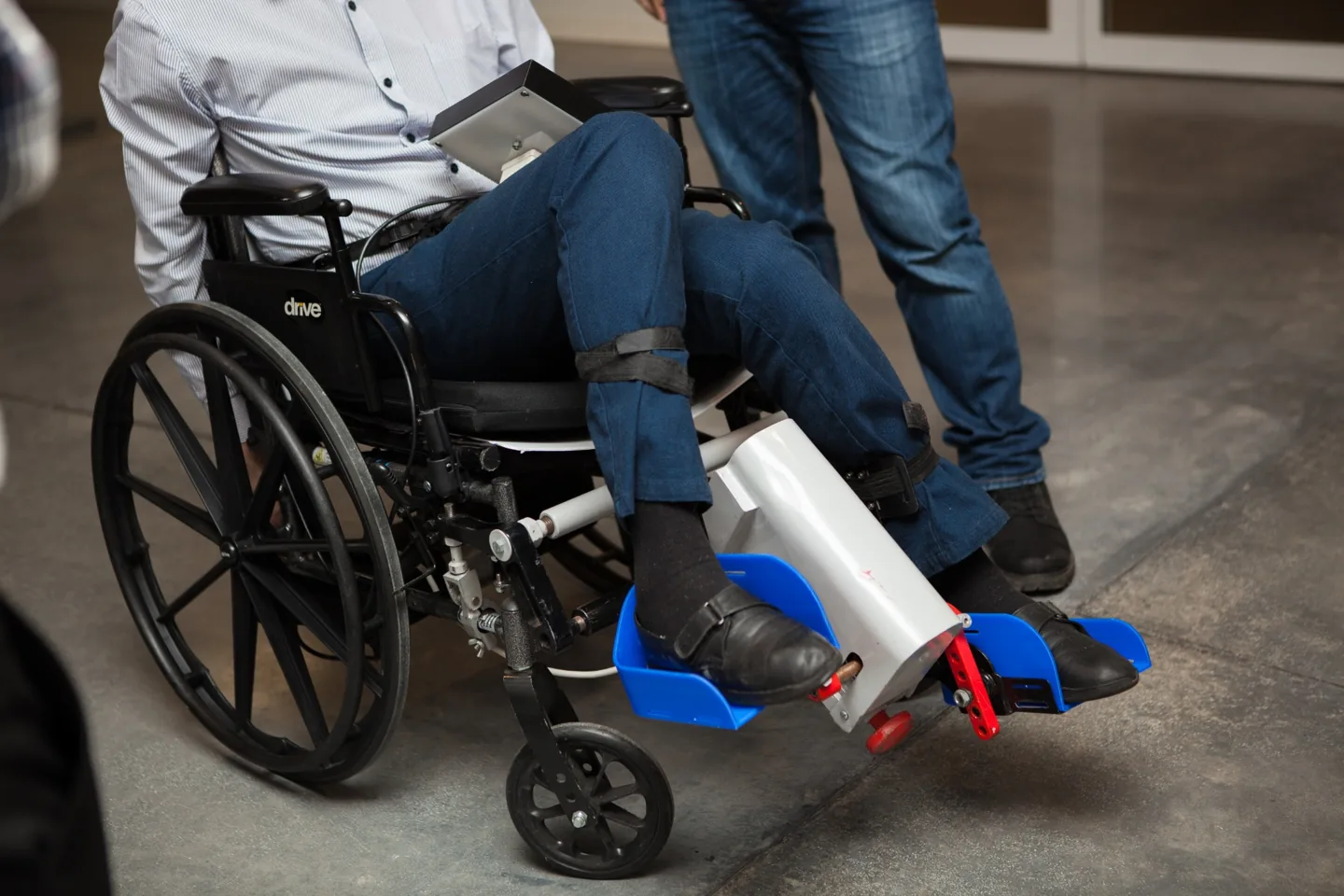
Clinical teams coordinate patient movement, equipment, staffing and therapy schedules. Transferring to a separate exercise station may introduce additional workflow demands for some patients.
Investigate whether wheelchair-integrated lower-limb cycling could be evaluated within a supervised rehabilitation workflow.
LegMaker is an investigational wheelchair-mounted lower-limb exercise concept. Suitability depends on the individual, device compatibility, supervision and future evaluation.
Define clinical eligibility, infection control, safety protocols, device compatibility, staffing needs and measurable endpoints before any clinical efficacy claim.
Interview users and practitioners to define the real workflow and unmet needs.
Test usability, safety requirements and practical feasibility under an appropriate protocol.
Report measured results transparently before making performance or health claims.
The Hospital Lab explained
A clear look at the person, the practical barrier, the proposed research workflow and what is still unproven.
Our starting point is the user's daily experience, not a technology claim.
Patient transfers, staffing, cleaning and scheduling can complicate introduction of exercise equipment.
No. This page describes a proposed research direction. Availability, eligibility and any future study depend on appropriate partners and approvals.
No. Wheelchair compatibility, individual safety considerations, supervision and investigational status must be assessed. Do not treat this page as medical advice or operating instructions.
Contact Rehabwheel to discuss the problem, feasibility questions, possible study design and requirements for a responsible evaluation.
Are you a researcher, clinician, adaptive sports organization or potential evaluation partner? Contact the Rehabwheel team to discuss a possible study.
Discuss a research collaboration ↗Real people / documentary program
We are inviting clinicians and research collaborators evaluating prototype questions. to request a free, supervised 30-minute LegMaker consultation and investigational prototype demonstration at the Humanmade facility in San Francisco, subject to confirmation.
No staged testimonials. No invented results. Just authentic conversations, documented demonstrations, and participant-controlled storytelling.
After a demonstration, participants may separately choose whether to share a photo, video, or quote. Filming and publication are optional and require separate informed consent.
Schedule your free consultation ↗This is an invitation to request a time, not an instant confirmed appointment. The investigational prototype is not presented as an established treatment.
How it works
Request a date at least 24 hours in advance. Sessions are requested between 9 AM and 9 PM Pacific.
Our team reviews availability, wheelchair compatibility and safety considerations.
Join a 30-minute consultation and supervised prototype demonstration, if approved and scheduled.
Verified / participant-approved
Only real, approved demonstration stories are published here. Filming is optional and never required for a consultation.
Loading published stories…